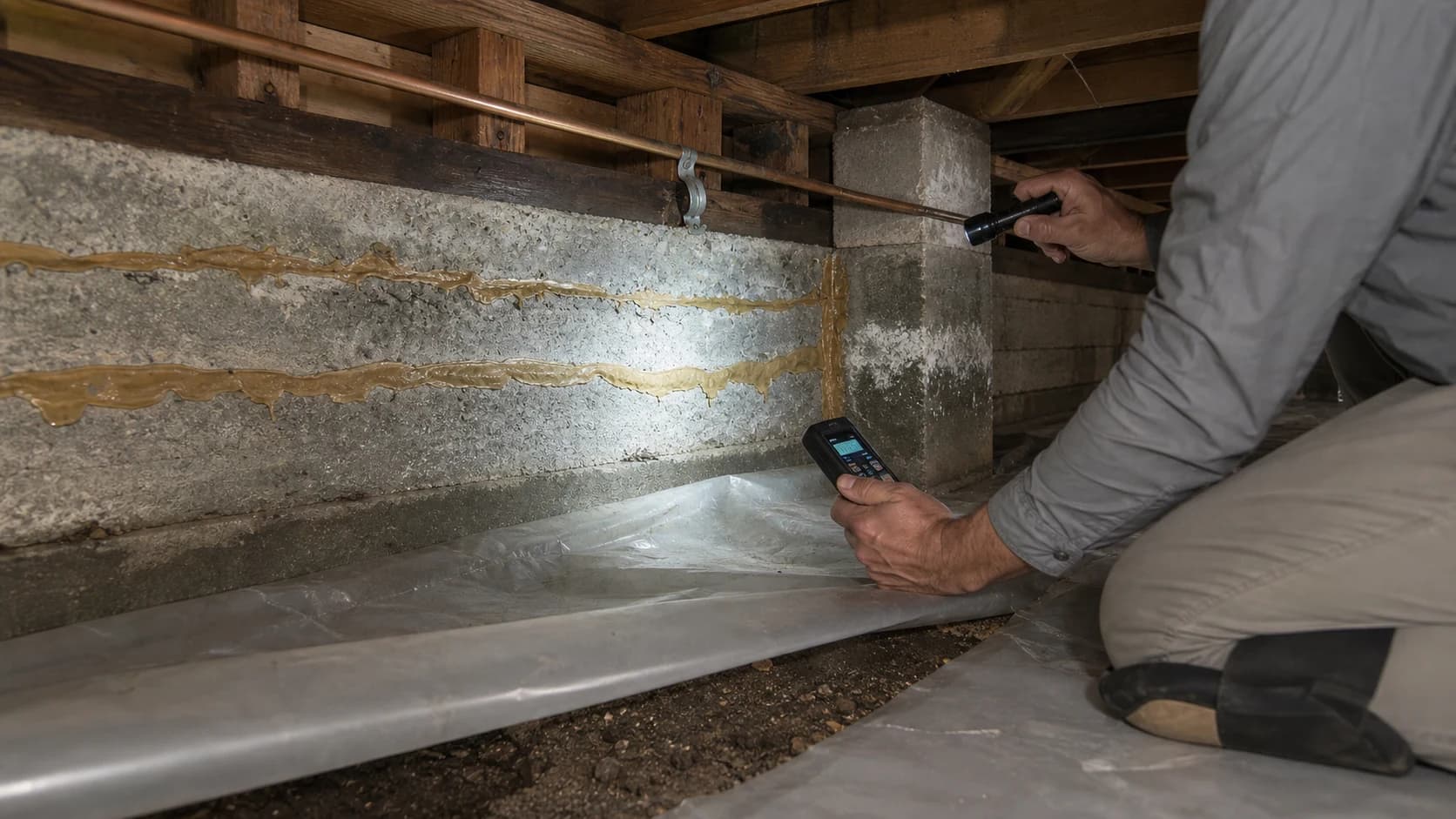
Water in a crawl space does not tell you what failed. Roof runoff, reverse grading, a plumbing leak, groundwater, and condensation can produce similar wet conditions. The useful questions are where the water starts, how long materials remain wet, and whether the moisture appears with cracks, damaged supports, corrosion, or floor movement.
A Pleasanton inspection showed why those questions need to stay separate. Relative floor-elevation measurements were within the report's selected screening tolerance at the time of the visit. The crawl space still contained saturated soil and standing wetness beneath parts of the vapor barrier. The engineer also documented a long horizontal foundation crack with an older sealant repair, salt deposits on concrete piers, and poor exterior drainage. The elevation survey did not erase those findings because it measured a different part of the problem.
Key takeaways
- A wet crawl space is a condition to investigate, not a foundation diagnosis by itself.
- Recurring standing water, saturated soil, damaged supports, corrosion, or a horizontal foundation crack makes the structural context more important.
- Efflorescence shows that moisture has carried salts through a porous material. It does not prove structural failure on its own.
- Floor-elevation measurements record the shape of the floor at one point in time. They do not rule out moisture damage or explain the source of water.
- Find the source before choosing encapsulation, drainage, crack repair, or structural work.
When crawl-space moisture becomes a foundation concern
One damp patch after a known plumbing leak calls for a different response than wet soil that returns after every storm. The concern rises when moisture persists, spreads, or appears with changes in the structure.
Look for combinations such as:
- standing water or saturated soil that returns after rain;
- roof runoff or hardscape directing water toward the house;
- wet, stained, softened, or decayed wood at beams, joists, posts, or sill plates;
- rust or corrosion on metal connectors, posts, pipes, or fasteners;
- a horizontal crack, a wall that appears bowed, or a crack that has changed;
- previous injection, patching, added posts, or other repairs with no records;
- new floor slope, drywall cracks, stucco cracks, or doors that have started binding.
FEMA's homeowner guidance groups standing water, concrete cracks, moisture-damaged wood, and corrosion among the conditions that can compromise a foundation or weaken crawl-space supports. These observations do not establish the cause. They tell you that the inspection should extend beyond water removal.
What the Pleasanton inspection found
The Pleasanton home had both a crawl-space foundation and a slab area. The engineer spot-checked interior elevations with a laser level. The report concluded that the measured variation in each area remained within its selected screening tolerance.
Inside the crawl space, the visual evidence told a less reassuring story:
- portions of the vapor barrier covered saturated soil or standing wetness;
- a continuous horizontal crack ran through a concrete foundation wall;
- tan sealant along the crack showed that someone had attempted a prior injection repair;
- several concrete support piers had white salt deposits and signs of past repair;
- some post-to-pier connections needed closer review;
- exterior downspouts discharged near the foundation, including at the property's low corner.
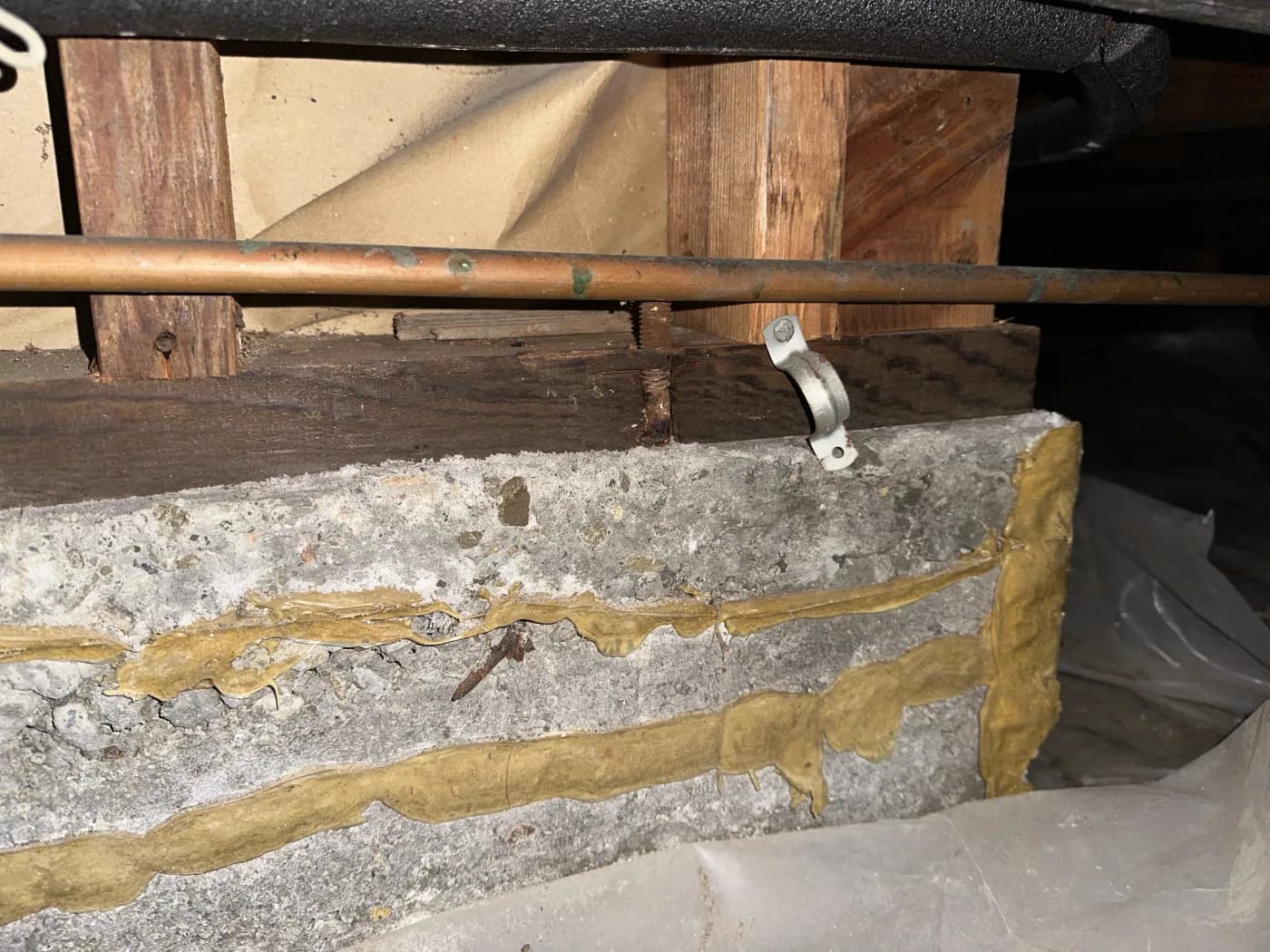
The inspection also recorded vertical drywall cracks, an exterior stucco crack, and softened or corroded exterior material near the area where water collected. Those finish cracks were relevant because they appeared alongside poor drainage and crawl-space moisture. They still did not prove that current foundation movement caused every crack.
The report raised alkali-aggregate reaction as one possible explanation for the unusual concrete cracking. It did not confirm that diagnosis. A visual, non-destructive inspection cannot identify the chemistry inside the concrete. Core sampling or other material testing would be needed before treating that possibility as fact.
Why normal floor elevations do not close the case
A relative floor-elevation survey answers a narrow question: how high or low are selected points compared with a reference point on the inspection date? The pattern can help an engineer locate a low area, compare it with a beam line or support, and establish a baseline for later monitoring.
The survey does not show when the variation developed. It also does not measure hidden decay, concrete chemistry, connector condition, drainage performance, or how often the soil under a vapor barrier becomes saturated. One survey cannot establish whether movement is active unless there is reliable earlier data for comparison.
This is why an elevation result within a screening tolerance and a poor crawl-space condition can both be true. The first finding reduces concern about large measured distortion at that moment. The second identifies moisture and material conditions that still need a source, scope, and response.
The broader California foundation inspection guide explains how engineers combine floor readings with crack patterns, framing, repair history, and site drainage.
What white powder on concrete means
White or gray powder on a concrete pier is often efflorescence. Water dissolves salts in soil, concrete, mortar, or nearby materials. As that water moves through a porous surface and evaporates, it can leave salts behind.
The National Park Service describes efflorescence as a warning that water has found a path into masonry. Its glossary includes concrete among cementitious masonry materials. The deposit itself may be more cosmetic than harmful, while salt crystallization below the surface can be more damaging in some materials.
For a homeowner, the practical response is to document the location and look for the water source. Repeated efflorescence near wet soil, standing water, or a leaking downspout supports a moisture investigation. It does not tell you how much load a pier can carry or whether the foundation is moving.
Trace the water before selecting a repair
The U.S. Environmental Protection Agency recommends controlling liquid water at its source. Its moisture guidance covers grading, roof runoff, plumbing, groundwater, and ground moisture in crawl spaces. The right solution depends on which path applies to the house.
Start with a short record of conditions:
- Photograph the crawl space during dry weather and after rain.
- Mark where the soil, vapor barrier, wood, concrete, or metal is wet.
- Check whether gutters overflow or downspouts end beside the foundation.
- Look for hardscape and low spots that hold water against the house.
- Rule out active supply, drain, irrigation, condensate, or appliance leaks.
- Note whether cracks, floor slope, doors, or finish damage changed at the same time.
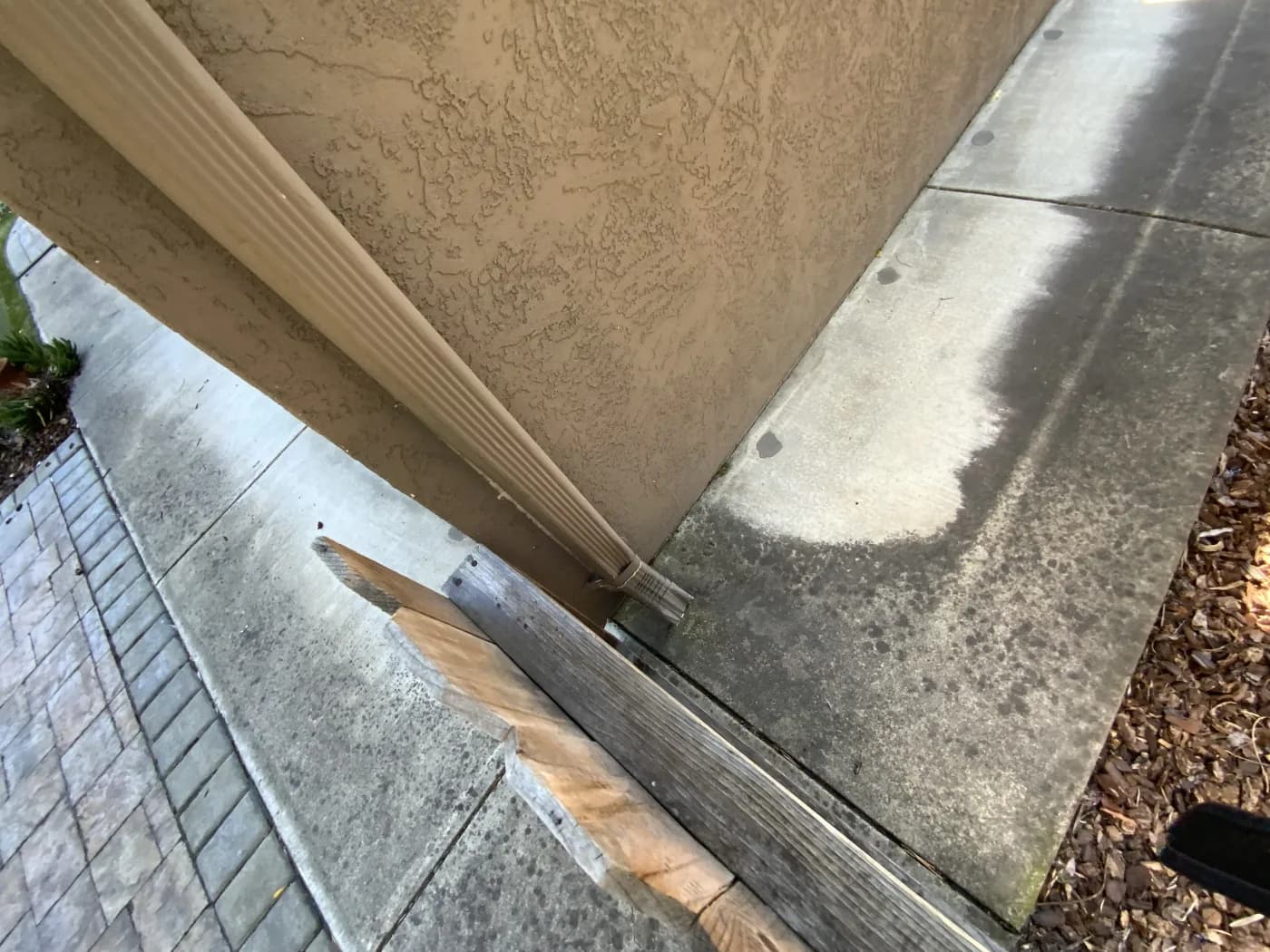
In the Pleasanton case, a downspout ended at the low exterior corner beside hardscape. The wall and paving showed a clear wetting pattern. That observation connected roof drainage to the part of the property where moisture was collecting, but it did not by itself define the final drainage design.
Avoid selecting a French drain, sump, encapsulation system, or crack injection from a symptom alone. Each method solves a different water path. A repair can hide evidence or redirect water without correcting the source if the diagnosis is wrong.
EPA's home moisture-control guidance recommends fixing leaks and seepage, sloping ground away from the house, and covering dirt crawl spaces to limit ground moisture. Climate, soil, access, discharge location, and local requirements still affect the design.
Who to call for water in a crawl space
The first call depends on the evidence you have:
- A plumber is appropriate when a supply line, drain, condensate line, or fixture may be leaking.
- A roofing, gutter, or drainage professional can trace roof runoff and visible surface-water paths.
- A licensed civil or structural engineer is appropriate when water appears with foundation cracks, altered supports, corrosion, floor movement, or a proposed structural repair.
- A geotechnical engineer may be needed when groundwater, expansive soil, slope movement, or soil-foundation interaction drives the problem.
California's Board for Professional Engineers, Land Surveyors, and Geologists explains that civil engineers may evaluate foundations and drainage when competent to do so. Geotechnical engineers specialize in soil, rock, groundwater, and their interaction with foundations. Check the professional's current license and ask whether their scope covers diagnosis, testing, repair design, or construction observation.
If you need the moisture findings interpreted with cracks, floor levels, piers, posts, and framing, a foundation inspection by a licensed engineer can establish what is observed, what remains unknown, and which specialist should handle the next step.
What a useful inspection should document
A crawl-space foundation inspection should be explicit about its limits. A typical visual, non-destructive scope may include:
- the homeowner's leak, drainage, repair, and symptom history;
- interior cracks, floors, doors, and transitions between foundation types;
- accessible foundation walls, piers, posts, beams, joists, and connectors;
- moisture, staining, decay, corrosion, efflorescence, and vapor-barrier condition;
- exterior grading, gutters, downspouts, hardscape, irrigation, and low points;
- floor-elevation measurements when they help answer the inspection question;
- photographs, an assessment, priorities, and clear recommendations for monitoring or further work.
The report should separate observations from interpretation. It should also state when access was blocked or when destructive testing, plumbing diagnostics, drainage design, or geotechnical work falls outside the inspection.
The Oakland foundation inspection case study shows how moisture, cracks, supports, and repair priorities can be documented together. The Fremont drainage and settlement case study shows how exterior water management and elevation data inform the same evaluation without making one symptom carry the whole diagnosis.
Frequently asked questions
Is water in a crawl space always a foundation problem?
No. The source may be plumbing, roof runoff, grading, groundwater, or condensation. It becomes a foundation concern when water persists or appears with cracks, damaged supports, corrosion, soil movement, or changes in the floors and walls.
Does efflorescence mean the concrete is failing?
No. Efflorescence shows that moisture carried soluble salts to a surface. Its location and recurrence can help trace moisture, but an engineer needs other evidence to judge the concrete and the load it supports.
Is a horizontal foundation crack always serious?
A horizontal crack deserves careful review because its direction can be associated with wall stress. Its width, length, change, wall shape, reinforcement, moisture, and repair history all affect the assessment. A photograph or crack direction alone cannot determine the repair.
Can acceptable floor elevations rule out foundation damage?
No. Relative elevations describe the measured floor geometry at one point in time. They do not rule out moisture damage, corrosion, connector defects, concrete deterioration, or a drainage problem.
Who should I call first for a wet crawl space?
Start with the likely source. Call a plumber for an active plumbing leak and a drainage professional for clear roof or surface-water problems. Add a licensed engineer when structural cracks, supports, floor movement, material deterioration, or a repair design is part of the question.