Walnut Creek homeowners often hear two rules before planning a backyard ADU: detached units can use four-foot side and rear setbacks, and trees nine inches or larger need City review before removal. Both statements appear in current City materials, but they do not tell the whole story. The current ADU ordinance expressly exempts certain state-exempt ADUs from the City's private-tree preservation chapter. The right first step is to identify the exact ADU category and jurisdiction before treating a tree as removable or untouchable.
Key takeaways
- Confirm that the property is inside the incorporated City of Walnut Creek. A Walnut Creek mailing address can still fall in unincorporated Contra Costa County.
- A qualifying state-exempt detached ADU can be up to 800 square feet, use four-foot interior side, corner-side, and rear setbacks, and follow the City's stated height rules.
- Walnut Creek's general tree-removal page requires a permit for a dead or living tree at least nine inches in diameter, measured 4.5 feet above grade.
- The current ADU code says specified state-exempt ADUs are exempt from Title 3, Chapter 8, Preservation of Trees on Private Property.
- Confirm the ADU type and any separate site, fire, utility, hillside, or safety review before moving or removing a tree.
1. Confirm the permitting jurisdiction
Start with the parcel, not the mailing address. The City notes that parts of Northgate, Saranap, the Pleasant Hill BART area, and portions of Walnut Heights have Walnut Creek addresses but sit outside City limits. Those properties follow Contra Costa County planning and tree rules.
Use the parcel number and an official jurisdiction map or contact the City before relying on Walnut Creek's ADU page. This one check prevents a common mistake: building a detailed feasibility study around rules that belong to the wrong agency.
2. Identify the ADU category first
Walnut Creek's current code separates state-exempt ADUs from other ADUs. For a single-family lot, one state-exempt type is a detached new-construction ADU that does not exceed 800 square feet and is at least four feet from the interior side, corner-side, and rear lot lines.
The City's public ADU page gives the same practical baseline:
- up to 800 square feet for a new state-exempt structure;
- four-foot side and rear setbacks unless a qualifying replacement-structure rule applies;
- a 16-foot baseline height for a detached ADU;
- up to 18 feet on a lot within one-half mile walking distance of a major transit stop or high-quality transit corridor, with up to two additional feet to match the primary dwelling's roof pitch.
These numbers define a zoning envelope, not a guaranteed buildable rectangle. Easements, fire access, utilities, drainage, building-code separation, grading, and site-specific hazards can still change the footprint. A front setback may also be reduced as needed to accommodate an ADU up to 800 square feet, but that does not erase other safety or access requirements.
3. Read the tree rule and ADU exemption together
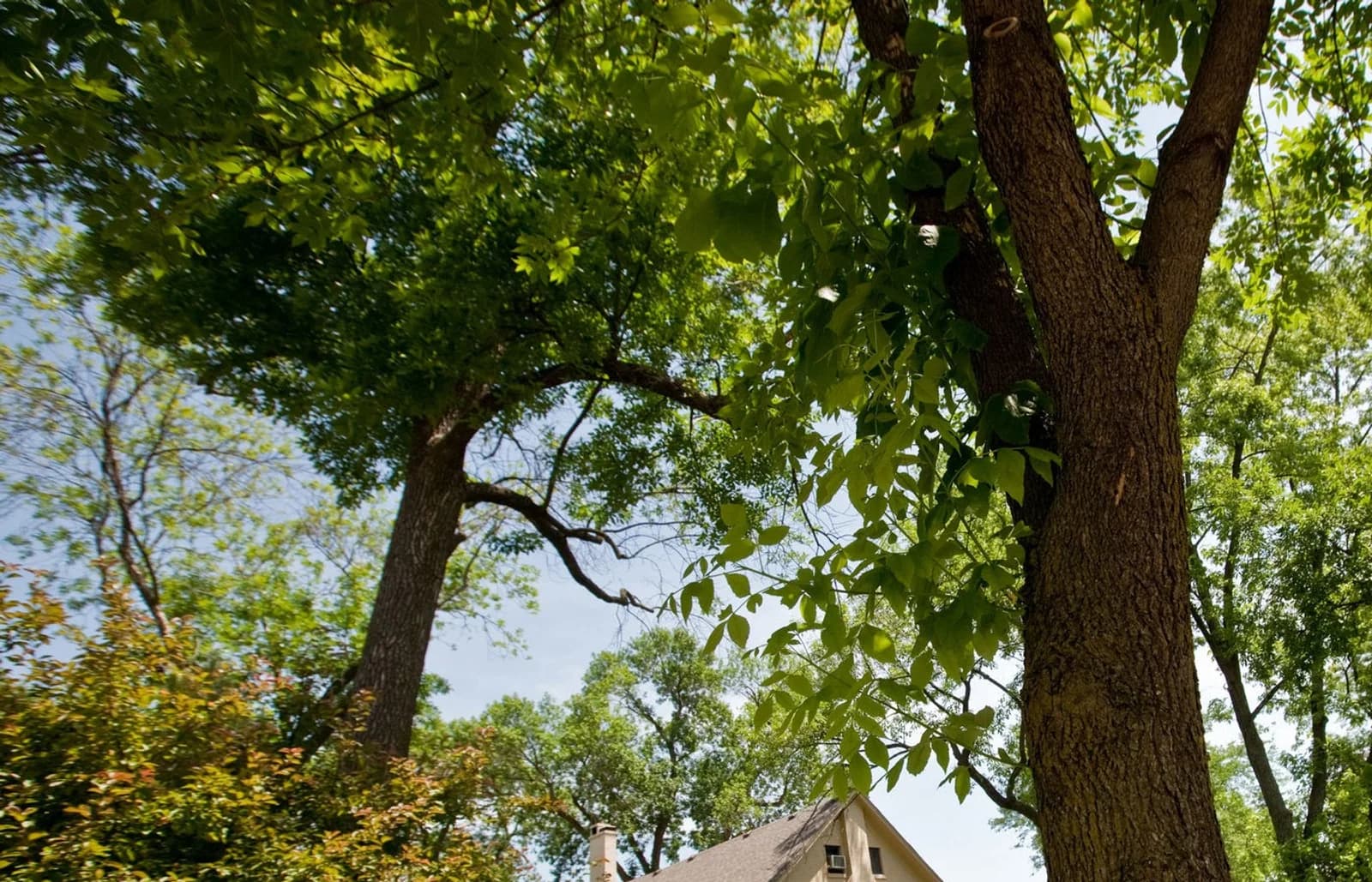
Walnut Creek's Tree Removal Permit page says a permit is required to remove a dead or living tree within City limits unless the tree is less than nine inches in diameter measured 4.5 feet above the ground. The page also says leaves or needles alone are not a valid reason for removal. Before approval, the City Arborist visits the site and considers health, structure, fall risk, proximity to buildings, utility conflicts, pavement damage, and effects on other trees.
Read alone, that page sounds universal. The current ADU ordinance adds an important exception. Section 10-2.3.504 says the state-exempt ADU types listed in the code are exempt from property development regulations elsewhere in the zoning chapter and from Title 3, Chapter 8, Preservation of Trees on Private Property.
The two official pages answer different questions:
- The tree page explains the general permit process for removing trees.
- The ADU code identifies which ADU categories receive state-law exemptions from local development and tree-preservation rules.
Do not assume that the general tree threshold automatically blocks a qualifying state-exempt ADU. Do not assume the exemption authorizes every tree impact either. A project outside the listed state-exempt category, or one that affects public trees, grading, encroachment, or separate safety requirements, may follow a different path. Send a dimensioned site plan and tree survey to the City when the classification is uncertain.
4. What the oak-tree project taught us
On one Cecilia Home detached ADU design, the first footprint overlapped a mature oak. The team mapped the trunk and surrounding canopy on the site plan, shifted the unit forward, and adjusted the orientation so the design could preserve the tree.
That choice is not proof that every oak must remain or that every state-exempt ADU needs a tree-removal hearing. The project-specific lesson is more useful: a four-foot setback does not tell you where the foundation should go. Existing trees, roots, drainage, access, and the homeowner's priorities belong on the feasibility plan before the floor plan is fixed.
Moving a footprint early is usually a smaller design change than redesigning foundations, utilities, windows, and energy calculations after a conflict is discovered. It can also preserve shade and yard character even when a legal exemption may be available. A permit-ready ADU design process should resolve these site constraints before detailed drawings.
5. Ministerial ADU review is not the same as no review
The current Walnut Creek Municipal Code requires the City to approve or deny a complete ADU application ministerially, without discretionary review, within 60 days when the statutory conditions apply. The City's approvals page also lists ADUs and building permits as examples of ministerial approvals.
Ministerial means the City applies objective standards rather than deciding the project through a discretionary public hearing. It does not mean that incomplete plans are automatically approved or that separate permits disappear. Fire, sanitary, utility, site-development, demolition, or tree-related questions can still require information or coordination appropriate to their scope.
The practical goal is a complete application that shows how the site works. A useful detached ADU submittal starts with a survey or reliable base plan and clearly identifies property lines, setbacks, existing buildings, easements, utilities, trees, grading, drainage, access, and the proposed footprint. Cecilia Home's building permit service focuses on coordinating that evidence before submission.
6. Check the PRADU status before choosing a plan
Walnut Creek has offered City pre-reviewed detached ADU plans, called PRADU plans. The current PRADU page says those plans are temporarily unavailable while the City updates them for the 2025 Building Code.
When the plans become available again, the City says they cannot be revised and must be permitted as designed. They may be oriented in different directions, and the floor plans may be mirrored or flipped. Applicants still need a valid site plan, construction permits, fees, outside-agency approvals, inspections, and a certificate of occupancy.
That makes PRADU a plan-check shortcut, not a site-feasibility shortcut. A fixed plan can save architectural review time only if its footprint, access, utilities, foundation approach, and openings work on the actual lot.
7. A pre-design feasibility checklist
- Confirm the parcel and permitting jurisdiction.
- Identify whether the proposal fits the current state-exempt detached ADU category.
- Draw property lines, easements, the house, accessory structures, utilities, drainage, and access.
- Locate trees near the study area and measure trunk diameter at 4.5 feet above grade.
- Show the proposed foundation in relation to trunks, canopy, and known site constraints.
- Check the current height rule and whether the transit provision applies to the parcel.
- Ask the City to clarify the tree-rule interaction if the project type or separate permits are uncertain.
- Confirm fire, sanitary, water, and other outside-agency requirements before completing the permit set.
- Recheck the current PRADU availability if a pre-reviewed plan might fit the site.
This order protects the design work. It also gives the City a specific plan to respond to instead of a general question about whether an ADU is allowed. Homeowners comparing neighboring jurisdictions can review the San Mateo County ADU permit guide for a separate city-specific workflow.
Frequently asked questions
Does every nine-inch tree block a Walnut Creek detached ADU?
No. The nine-inch threshold appears in the City's general tree-removal process, while the current ADU ordinance exempts specified state-exempt ADUs from the private-tree preservation chapter. Confirm the exact ADU category and any separate approvals before deciding that a tree blocks the project.
Does a qualifying detached ADU need a public hearing?
The current code calls for ministerial review without discretionary review or a hearing for a complete ADU application. A project that seeks separate discretionary approvals follows the process for those approvals.
Can I change a Walnut Creek PRADU plan?
The current City page says PRADU plans cannot be revised, although they may be oriented, mirrored, or flipped. The same page says the plans are temporarily unavailable while being updated for the 2025 Building Code.
Is the 18-foot height allowance limited to BART?
The current Municipal Code uses one-half mile walking distance from a major transit stop or high-quality transit corridor. The City's summary page describes the local example as a BART station. Confirm the parcel's eligibility rather than relying on straight-line distance alone.